
Overview #
The water gas shift (WGS) reaction converts CO and steam into H₂ and CO₂ over a packed bed catalyst. One of its main industrial uses is adjusting the CO:H₂ ratio of syngas streams to suit downstream synthesis — Fischer-Tropsch synthesis, for example, requires a 1:3 CO:H₂ ratio. This project models a combined WGS and CO₂ capture reactor and determines how long it should run before the buffer tank reaches that target ratio, at which point the system switches to CO₂ desorption.
Reactor Design #
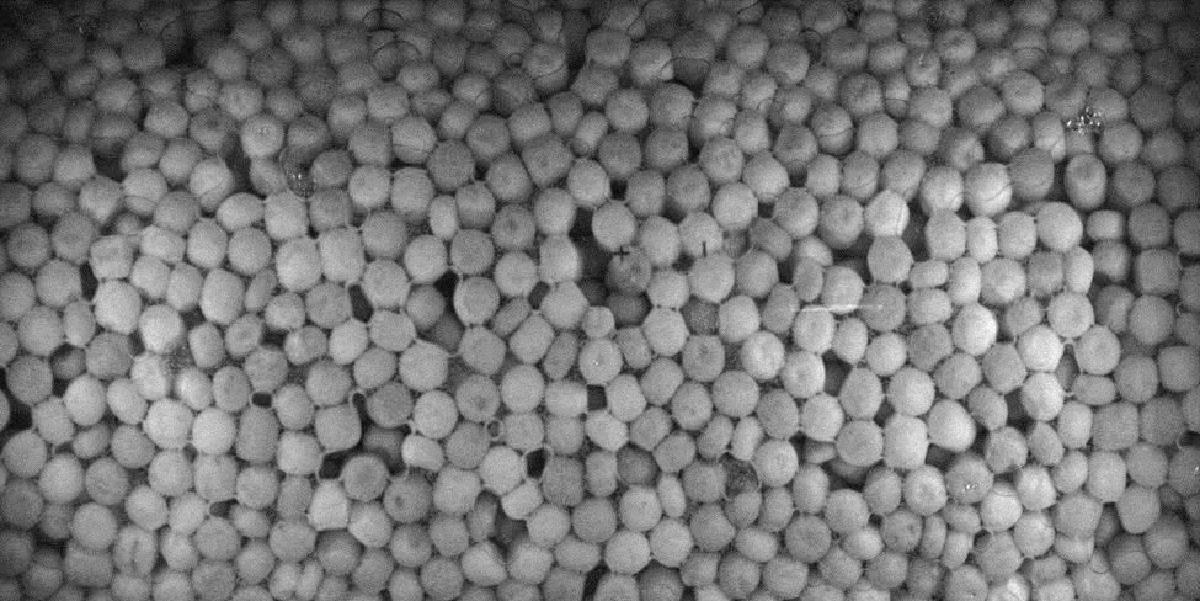
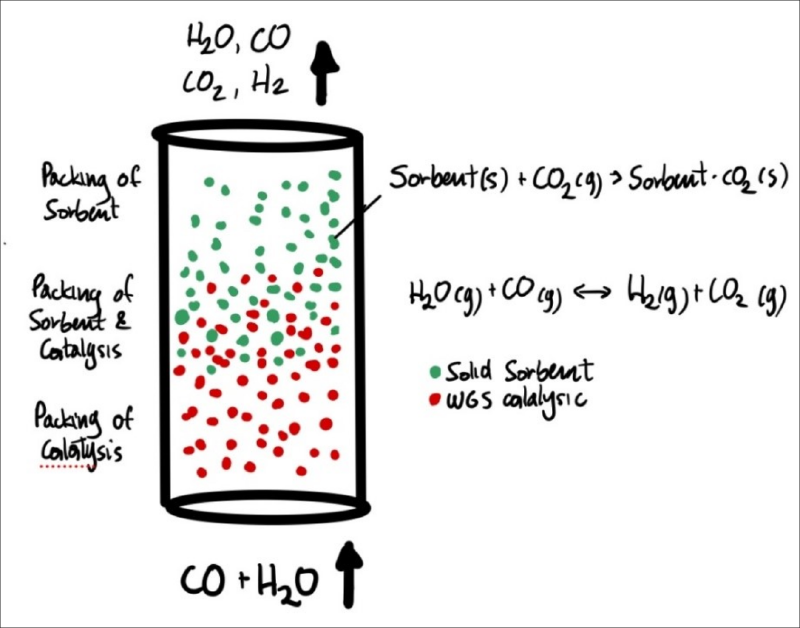
The reactor is a fixed bed with two packed sections in series. The first section carries a low-temperature WGS catalyst operating at 207°C, selected for its low cost, good stability, and compatibility with the target operating conditions. The second section is packed with a solid sorbent that captures CO₂ via physical adsorption at elevated temperatures, removing it from the product stream as it forms.
This arrangement lets both reactions happen simultaneously in a single vessel: the WGS reaction produces H₂ and CO₂, and the sorbent immediately captures the CO₂ downstream, keeping the product stream clean and shifting the reaction equilibrium further toward completion.
Modeling and Results #
The system was modeled in MATLAB by solving the coupled differential equations governing each species’ concentration over time. Outlet concentrations were integrated to track the cumulative moles of CO and H₂ accumulating in the buffer tank, and the CO:H₂ ratio was monitored until it hit the 1:3 target.
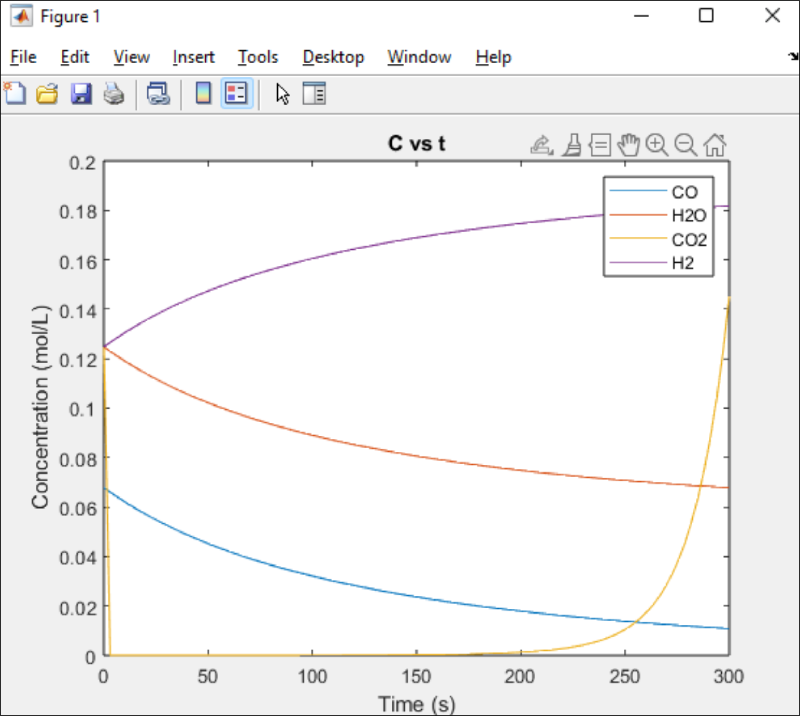
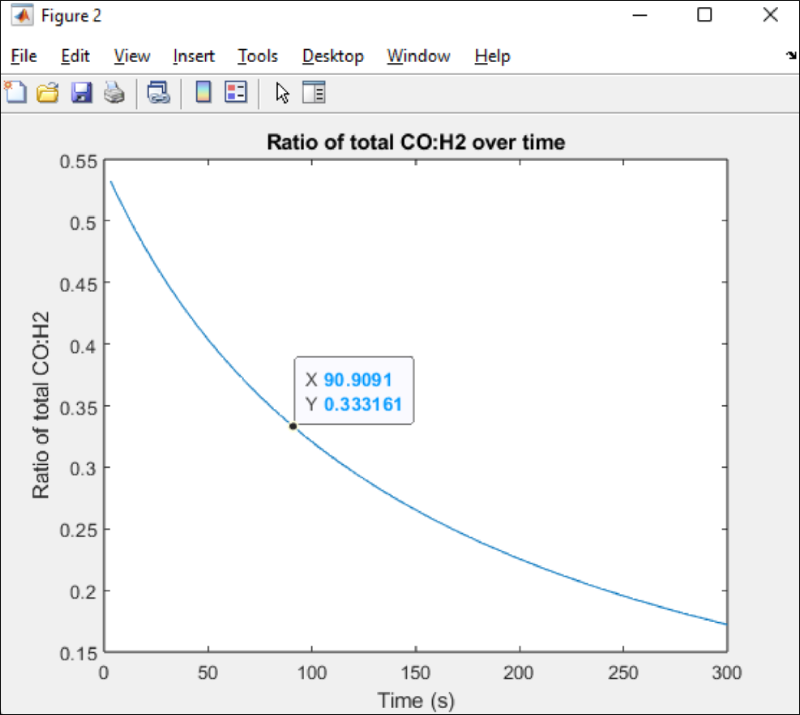
The target ratio is reached at approximately 91 seconds, giving a clear operational switching point between the adsorption and desorption phases.
Discussion #
Integrating CO₂ capture directly into the WGS reactor is useful beyond just hitting a syngas composition target. Removing CO₂ in-situ shifts the reaction equilibrium, improves H₂ yield, and produces a captured CO₂ stream suitable for sequestration or further conversion — all without a separate downstream separation unit. The design is a small-scale illustration of how reaction and separation can be coupled to improve both efficiency and environmental outcome in fuel synthesis processes.